What Is Reverse Engineering? A Plain-English Guide
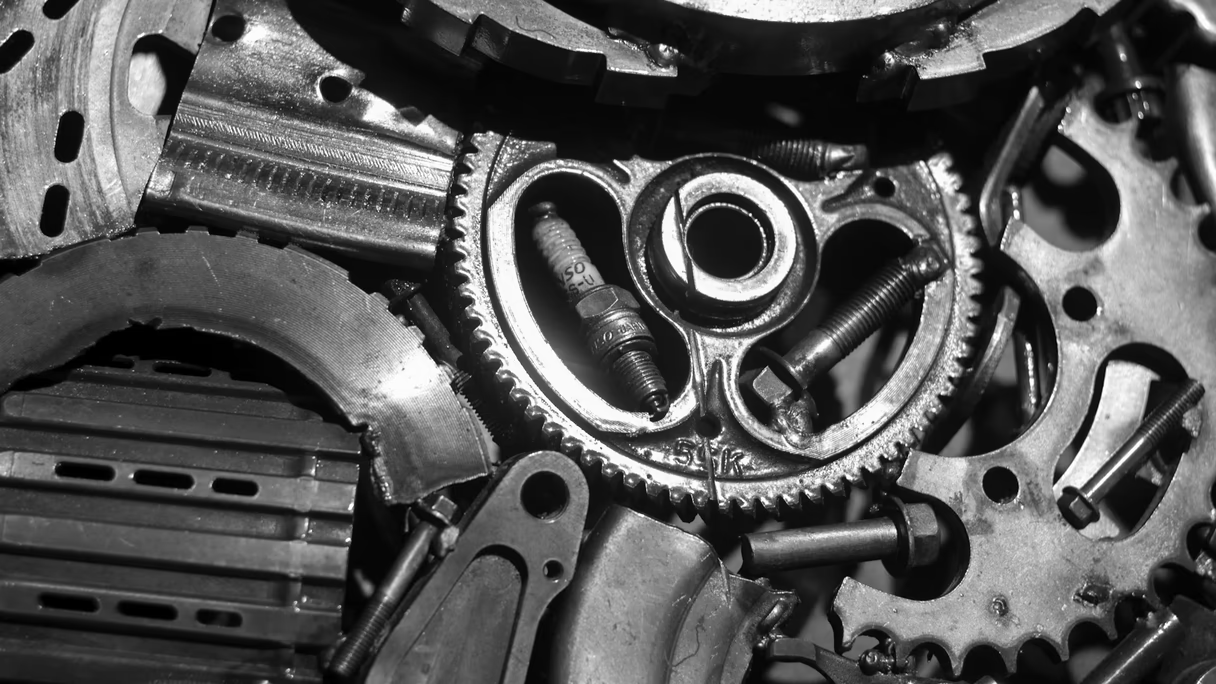
Reverse engineering is working backwards from a finished thing to the information needed to make it: from a part to its drawing, from a program to its logic, from a circuit board to its schematic. The term covers several fields that share nothing but the direction of work. This guide explains what reverse engineering means in each of them, and then goes deeper into the one we do: recovering the geometry of a mechanical part from a 3D scan, so the part can be made again, repaired or improved without its original drawing.
The fields that use the name
Mechanical parts and equipment. A part exists and its drawing does not: the supplier is gone, the drawing was never handed over, or the part was modified in the field. The part is measured, and its geometry is rebuilt as a CAD model that a machine shop, a foundry or a 3D printer can work from. This is the subject of the rest of this guide.
Software. A program is analyzed to understand how it works, usually by reading its compiled code. It is used for compatibility, security research and maintaining software whose source is lost.
Electronics. A circuit board or a chip is traced back to its schematic and components, for repair, obsolescence or analysis.
Products and systems in general. In business and design writing the term is used loosely for studying any competitor’s product to learn how it was made.
The legal questions differ by field and by what is being copied. Whether a part may be reproduced is a matter of the rights in it, which is a question for the owner of the part and their counsel, not for whoever measures it.
How a mechanical part is reverse engineered
The scan. Parts up to about four meters are scanned with a handheld scanner of the HandySCAN SILVER class, a metrology instrument that projects fourteen blue laser lines and is rated by its brochure at an accuracy of up to 0.040 mm, the brochure’s typical value for diameter measurements on a calibrated sphere. The scanner is moved around the part by hand, and the surface builds up on the screen as it is covered, so a missed patch is filled on the spot. The result is a mesh of the part’s surface in STL. Larger objects, a press frame or a section of a hull, are scanned with a terrestrial scanner of the Trimble X7 class, rated at a 3D point accuracy of 2.4 mm at 10 m (one standard deviation) by its datasheet.
From mesh to model. A mesh copies one worn part; a CAD model is the part as it was designed. A bore that measures 25.06 mm on a worn part was drawn at 25 mm, and a flange that sits a fraction of a degree off square was square when it left the machine. Rebuilding the model means recovering that design intent: setting the datum faces, restoring standard sizes and symmetries, and fitting the free-form surfaces that have no simple description as NURBS surfaces. Which features are restored to a nominal value and which follow the scan is agreed before the modeling starts, and the delivery lists them feature by feature.
The delivery. The CAD model in STEP, the ISO 10303-21 exchange format, with native formats on request; the scanned mesh in STL; and drawings in DWG and PDF when the part is going to be made again. The model is checked against the scan before delivery.
What a scan cannot see. A surface scan records what the light reaches. Deep bores, internal passages and the inside of a closed casting are documented by sectioning the part, measuring at the openings or from existing drawings, and the model says which features were scanned and which were not; the guide to internal features covers those options.
What it does not cover. Material, hardness, heat treatment and the engineering of loads and tolerances for a redesign stay with the client’s engineer; the model gives that engineer a correct starting shape.
Where it is used
Replacing a discontinued spare part for a machine that still runs; repairing a worn impeller, propeller or blade, as the guides to marine propellers and turbine and compressor blades show; re-making a casting with one change; fitting a new component to an existing assembly; or putting a legacy product into CAD so it can be maintained. The guide to how to scan an object into CAD walks through the steps in more detail.
Price and time
Reverse engineering of a single part starts at about $1,000 for the scan and the CAD model; assemblies and large equipment are quoted on their own. The quote arrives within one business day of your sending photographs of the part, its approximate size and what the model is for. A single part is usually scanned in a day, and the model usually follows in one to two weeks. The reverse engineering page describes the service, and we scan in all 50 states.
FAQ
What are some examples of reverse engineering?
Re-making a discontinued spare part from the old one, rebuilding a worn propeller or pump impeller as a CAD model, analyzing a compiled program for security research, or tracing a circuit board back to its schematic.
What is reverse engineering?
Working backwards from a finished thing to the information needed to make it. For a mechanical part, that means scanning it and rebuilding its geometry as a CAD model.
Is reverse engineering illegal in the US?
It depends on the field and on the rights in what is being reproduced. Whether a part may be copied is a question for its owner and their counsel.
How accurate is reverse engineering from a 3D scan?
A handheld scanner of the HandySCAN SILVER class is rated at up to 0.040 mm by its brochure. The CAD model is checked against the scan, and the features restored to a design value are listed.
What files do I get?
STEP for the CAD model, STL for the scanned mesh, and DWG and PDF drawings on request.
How much does it cost?
A single part starts at about $1,000 for the scan and the CAD model, with a quote within one business day.
Sources
- Creaform, HandySCAN 3D SILVER series brochure (2024): laser lines and accuracy.
- Trimble X7 3D laser scanning system datasheet: 3D point accuracy.
- ISO 10303 (STEP), list of parts: Part 21, clear text encoding of the exchange structure